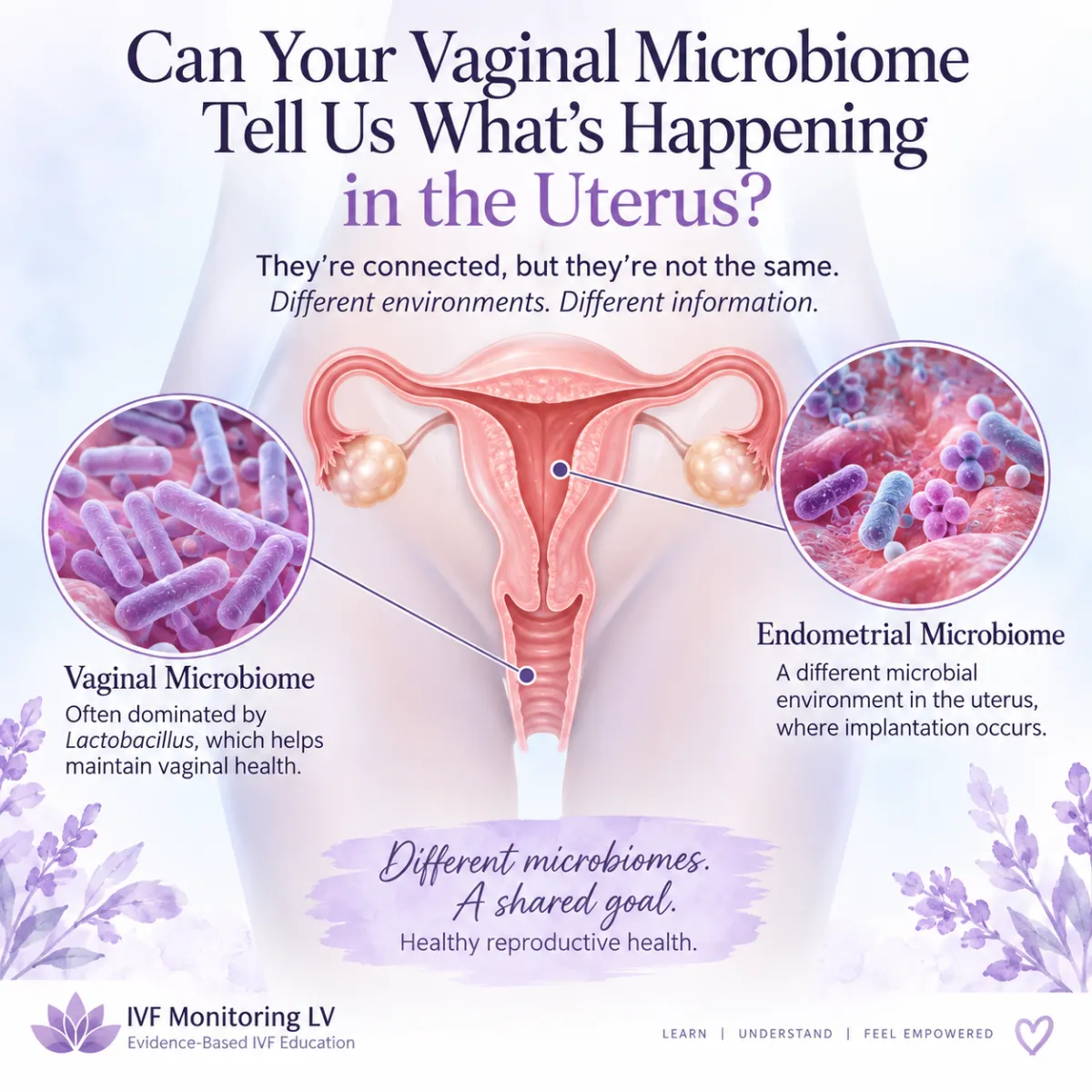
Can Your Vaginal Microbiome Tell Us What’s Happening in the Uterus?
Can Your Vaginal Microbiome Tell Us What’s Happening in the Uterus?
When fertility patients first hear about the endometrial microbiome, a very reasonable question often follows:
“Can't my doctor just test my vaginal microbiome instead?”
After all, the vagina and uterus are part of the same reproductive tract.
But they are different environments, and what we find in one doesn't necessarily give us a complete picture of the other.
The vaginal microbiome
The vagina contains a well-established community of microorganisms.
In many women, Lactobacillus species are prominent. These bacteria help maintain an acidic vaginal environment and are generally associated with vaginal health.
Researchers have also found associations between vaginal microbiome patterns and reproductive outcomes, including IVF outcomes. A 2025 systematic review and meta-analysis found better pregnancy and live-birth rates among women classified as having more favorable vaginal microbiome patterns, although the authors also noted limitations in the quality of the evidence.
That makes the vaginal microbiome an important area of fertility research.
But here's where we need to be careful.
The vagina and uterus are not the same environment
The endometrial microbiome refers to microorganisms detected within the lining of the uterus—the place where an embryo must ultimately implant.
The vaginal microbiome is much easier to sample. A vaginal swab can usually be obtained relatively simply and without entering the uterine cavity.
Obtaining an endometrial sample is more invasive and introduces another scientific challenge: because the sampling device must pass through the lower reproductive tract, researchers have to consider the possibility of contamination when interpreting uterine microbiome results.
So although these microbial environments may be related, they shouldn't automatically be considered interchangeable.
Can vaginal bacteria give us clues?
Possibly.
Researchers continue to investigate whether vaginal microbiome patterns could eventually serve as a less invasive biomarker for reproductive health or IVF outcomes.
Studies have found associations between certain vaginal microbial patterns and implantation, pregnancy, pregnancy loss and IVF outcomes. However, results across studies have not always been consistent. A large systematic review involving 6,835 IVF patients, for example, found vaginal dysbiosis associated with lower clinical pregnancy rates and greater early pregnancy loss, but it did not find a statistically significant effect on live-birth rates.
That distinction matters.
An association can tell researchers where to look next, but it doesn't necessarily prove that the microbiome caused an IVF outcome—or that changing it will improve the outcome.
Can a vaginal test replace an endometrial test?
At this point, I would not think of it that way.
A vaginal microbiome test tells us about the vaginal microbial environment.
An endometrial sample attempts to tell us about the uterine environment.
Research continues into how closely the two are related and whether easier, less-invasive sampling methods might eventually provide useful information about the uterus.
But right now, we should be careful about assuming:
“My vaginal microbiome looks healthy, therefore my uterine microbiome must be healthy.”
Or the reverse.
The science isn't that simple yet.
What should IVF patients ask?
If your fertility specialist recommends microbiome testing, instead of focusing only on which test to order, ask:
“What are we trying to learn from this test?”
Then ask:
“Will this test tell us about my vagina, my uterus—or both?”
And perhaps most importantly:
“How would the result change my treatment?”
Those questions help move the conversation away from simply collecting more test results and toward whether the information will actually help guide your care.
The takeaway
The vaginal microbiome is important, and emerging research suggests it may provide useful information about reproductive health and IVF outcomes.
But:
The vaginal microbiome and the endometrial microbiome are not the same thing.
A vaginal sample may provide clues, but it shouldn't automatically be considered a window into everything happening inside the uterus.
As we've seen throughout this series, microbiome research is moving quickly. The exciting part is that better research may eventually help us understand which patients benefit from testing—and which findings actually matter for treatment.
For now, keep asking the most important question:
“How will this information change what we do next?”
This information is for educational purposes and is not a substitute for individualized medical advice.