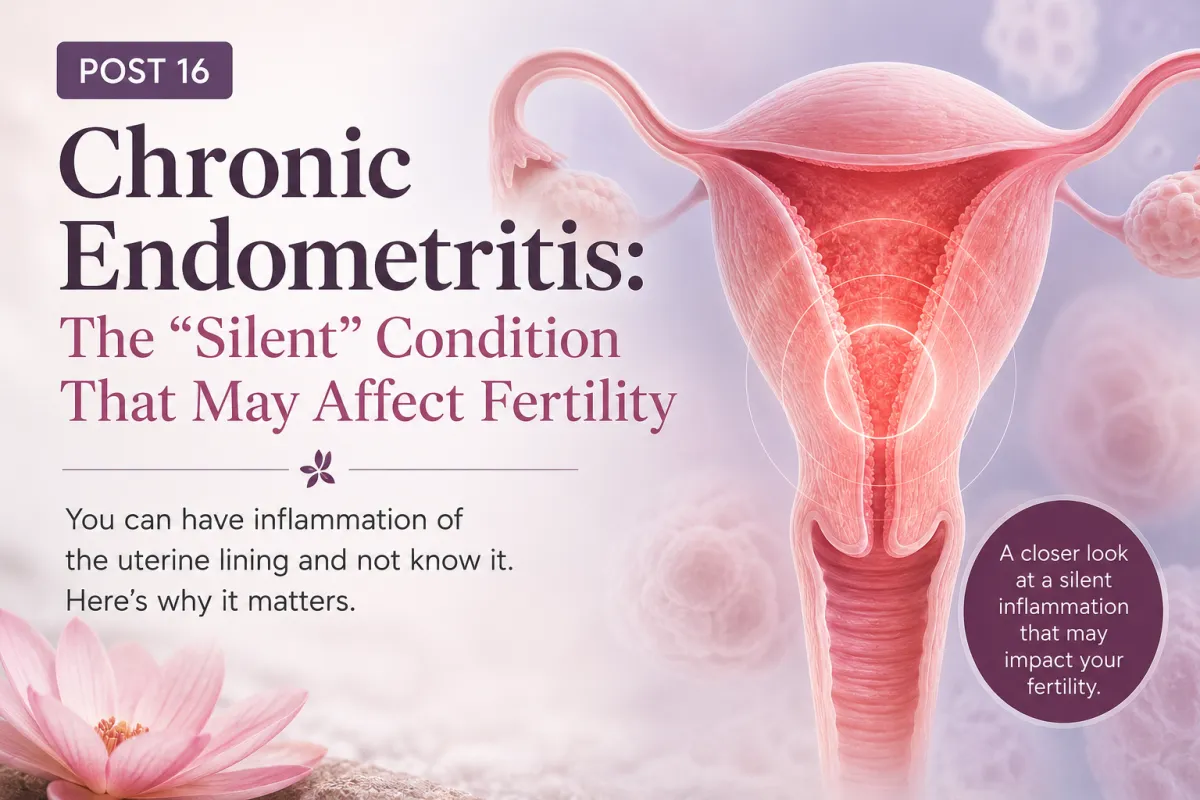
Chronic Endometritis: The “Silent” Condition That May Affect Fertility
Chronic Endometritis: The “Silent” Condition That May Affect Fertility
When you hear the word endometritis, you may imagine an infection that causes fever, significant pain or obvious illness.
But chronic endometritis is different.
Chronic endometritis—often shortened to CE—is persistent inflammation of the endometrium, the tissue lining the inside of the uterus.
And one of the most important things for fertility patients to understand is this:
You can have chronic endometritis without knowing you have it.
CE is frequently asymptomatic or associated with symptoms so mild and nonspecific that they may not immediately suggest a problem with the uterine lining. Recent reviews continue to describe this subtle presentation as one reason CE can be underdiagnosed.
Acute Endometritis and Chronic Endometritis Are Not the Same
Acute endometritis usually behaves more like what we traditionally think of as an infection.
A woman may experience fever, pelvic pain, abnormal discharge or other noticeable symptoms.
Chronic endometritis may be much quieter.
Instead of a sudden illness, there is persistent inflammation within the endometrial tissue. Under the microscope, one of its characteristic findings is the presence of immune cells called plasma cells in the endometrial stroma.
We'll talk much more about how those cells are detected in the next post.
What Symptoms Might Occur?
Some women with CE have no obvious symptoms at all.
When symptoms are present, they can be vague and may include:
Mild pelvic discomfort
Increased or unusual vaginal discharge
Abnormal uterine bleeding or spotting
Other nonspecific pelvic symptoms
None of these symptoms proves that a woman has chronic endometritis. And importantly, not having them does not necessarily rule it out.
That's one reason CE is particularly interesting in reproductive medicine.
Sometimes the Reproductive History Is the Clue
For some women, the reason chronic endometritis is investigated isn't because they feel sick.
Instead, the question arises because of their reproductive history.
Researchers have been studying CE in women experiencing infertility, recurrent pregnancy loss and recurrent implantation failure.
A 2024 systematic review and meta-analysis involving 1,038 women found CE in 19.46% of women with infertility compared with 7.7% of controls.
The difference was even more striking in recurrent pregnancy loss: CE was identified in 37.6% of women with RPL compared with 16.4% of controls.
Those numbers are interesting—but they need to be interpreted carefully.
The same analysis did not find a significant association between CE and recurrent implantation failure.
That's an important reminder that reproductive research rarely gives us a simple yes-or-no answer.
Why Would Inflammation in the Endometrium Matter?
The endometrium isn't simply a surface where an embryo lands.
It is biologically active tissue that undergoes remarkable changes every menstrual cycle in preparation for possible implantation.
Successful implantation requires communication among the embryo, endometrial cells, hormones, immune system and other components of the uterine environment.
Researchers are investigating whether persistent inflammation associated with CE can disturb some of those processes, including endometrial receptivity and embryo implantation.
We still have much to learn about exactly how important CE is—and which fertility patients are most affected.
Why Haven't I Heard About This Before?
Chronic endometritis isn't a brand-new disease.
What's changing is the amount of attention it is receiving in reproductive medicine.
Improved methods of examining endometrial tissue and growing interest in the uterine environment have led researchers to look beyond the embryo alone when trying to understand reproductive failure.
Professional reproductive organizations are paying attention too.
For example, ESHRE's recommendations on recurrent implantation failure recognize that CE can occur without clinical signs of infection and state that assessment for chronic endometritis can be considered in the evaluation of RIF. At the same time, ESHRE emphasizes limitations in the evidence and the lack of standardized diagnostic criteria.
We're going to examine professional guidance much more closely later in this mini-series rather than trying to squeeze it all into this introductory article.
An Important Message for Fertility Patients
If you have experienced infertility or pregnancy loss, this article is not suggesting that chronic endometritis is necessarily the explanation.
There are many possible causes of reproductive difficulties.
Instead, I want you to understand something broader:
Not every reproductive condition produces the classic symptoms we expect.
Sometimes a patient's history is what prompts a reproductive specialist to look more closely.
You don't need to diagnose yourself.
You need enough information to know that a condition exists and to ask your fertility specialist whether it could be relevant in your particular situation.
So How Do We Know If It's There?
That's where things become particularly interesting.
Because CE can be silent, symptoms alone aren't enough to diagnose it.
Doctors can examine a small sample of the endometrium and look for evidence of chronic inflammation—including those plasma cells we mentioned earlier.
And there is a particular laboratory marker called CD138 that you're going to hear much more about.
That's where we'll go next.