Probiotics and IVF: Can Lactobacillus Improve Your Chances of Pregnancy Post
Probiotics and IVF: Can Lactobacillus Improve Your Chances of Pregnancy
When you're going through IVF, you hear a lot about embryos—how many eggs were retrieved, how many fertilized, embryo grades, genetic testing and whether an embryo is considered suitable for transfer.
But an embryo is only half of the implantation story.
It also has to arrive in an environment capable of receiving it.
That's one reason researchers have become increasingly interested in the reproductive microbiome and, particularly, bacteria called Lactobacillus.
And a new study has given us another intriguing piece of the puzzle.
What Did the New Study Find?
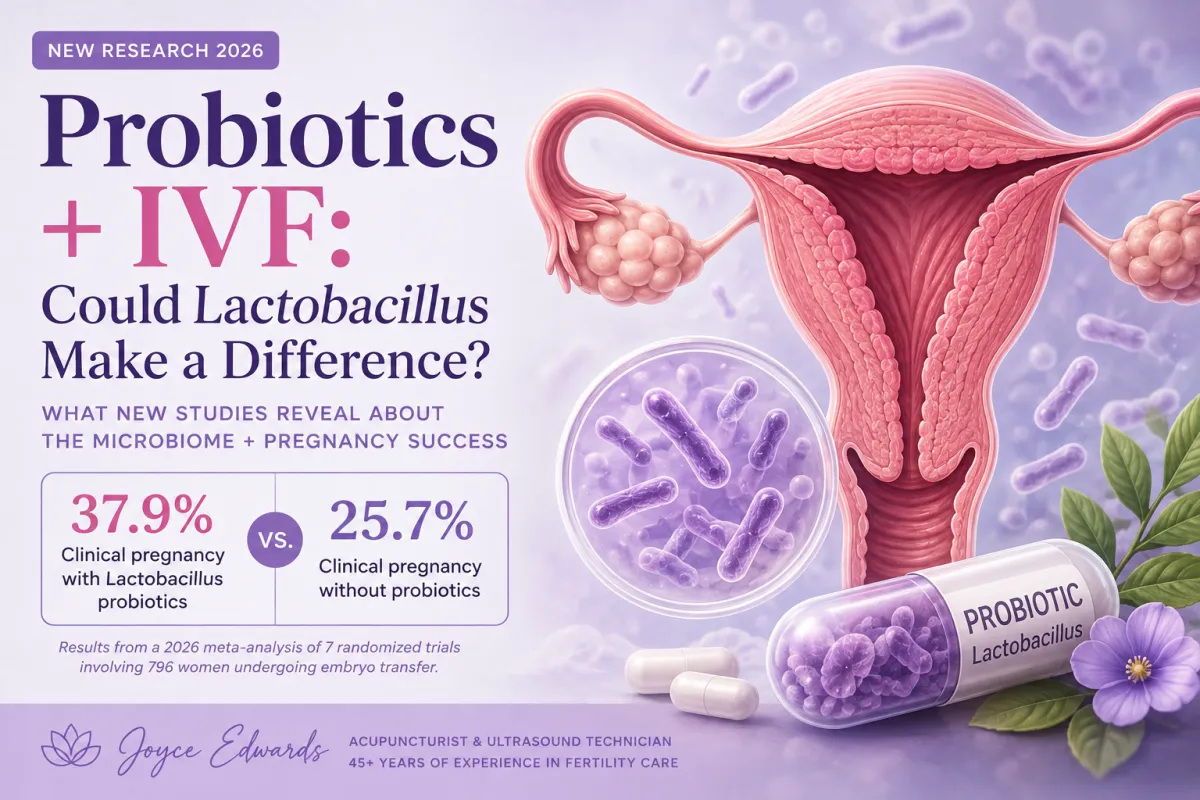
A 2026 systematic review and meta-analysis combined the results of seven randomized controlled trials involving 796 women undergoing embryo transfer.
Some women received probiotics containing Lactobacillus; others did not.
The researchers found:
Clinical pregnancy with probiotics: 37.9%
Clinical pregnancy without probiotics: 25.7%
That works out to approximately 12 additional clinical pregnancies for every 100 women treated in the studies.
Those numbers certainly get your attention.
But before you order a probiotic, there's more to the story.
Why Lactobacillus?
Lactobacillus is a group of bacteria commonly found in a healthy female reproductive tract.
These bacteria produce lactic acid and other substances that help maintain an environment that may discourage the growth of potentially harmful microorganisms.
Research has also raised the possibility that a Lactobacillus-dominant reproductive environment may be associated with implantation and pregnancy outcomes.
That has led researchers to ask an obvious question:
If Lactobacillus is associated with a healthier reproductive environment, could adding Lactobacillus through probiotics improve IVF outcomes?
We're beginning to get answers—but we don't have the complete answer yet.
Vaginal or Oral Probiotics?
This is an important detail.
Of the seven trials in the new analysis, six used vaginal probiotics and only one used an oral probiotic.
The studies also used different Lactobacillus strains, different doses and dramatically different treatment periods—from just six days to as long as 180 days.
That means this study cannot tell us:
Which Lactobacillus strain is best
What dose should be used
How long treatment should last
Whether oral and vaginal probiotics have the same effect
Which IVF patients are most likely to benefit
So simply buying a probiotic labeled “women's health” isn't the same thing as following one of the protocols studied in these trials.
There's Another Reason for Caution
Interestingly, an earlier 2025 meta-analysis also examined vaginal probiotics before embryo transfer.
It found clinical pregnancy rates of approximately 37.5% in women receiving probiotics compared with 31.6% in controls.
That difference was not statistically significant.
So while the newer analysis is encouraging, the scientific evidence isn't completely settled.
There was another important limitation in the new study: the primary outcome was clinical pregnancy, not live birth.
Seeing a pregnancy on ultrasound is an important milestone. But for an IVF patient, the outcome that ultimately matters most is bringing home a baby.
We still need better evidence showing whether probiotic treatment increases live-birth rates.
Should You Take a Probiotic Before Your Embryo Transfer?
This is where I would be careful.
These findings do not mean that every woman undergoing IVF should start taking a probiotic before embryo transfer.
Your reproductive microbiome is an ecosystem. More isn't automatically better, and treatment that may be appropriate for one woman isn't necessarily appropriate for another.
If you are interested in your reproductive microbiome—particularly if you've experienced implantation failure or pregnancy loss—this is something to discuss with your fertility specialist.
Questions you might ask include:
“Could my reproductive microbiome be relevant to my situation?”
“Is microbiome testing appropriate for me?”
“Would you recommend a probiotic before my embryo transfer?”
“If so, which strain, route and duration would you recommend?”
Those questions can start a much more useful conversation than simply adding another supplement on your own.
What I Find Exciting About This Research
For many years, IVF treatment has understandably focused heavily on the embryo.
But we're learning more about the environment that embryo enters.
The endometrium isn't simply a place where an embryo lands. It's a complex biological environment involving hormones, immune signaling, inflammation—and potentially microorganisms.
This new research doesn't give us the final answer about probiotics and IVF.
But it gives researchers another reason to keep asking an important question:
Can improving the environment surrounding an embryo help improve its opportunity to implant?
That's a question worth continuing to investigate.
This article is for educational purposes and is not a substitute for individualized medical advice. Discuss supplements, testing and treatment decisions with your fertility specialist.