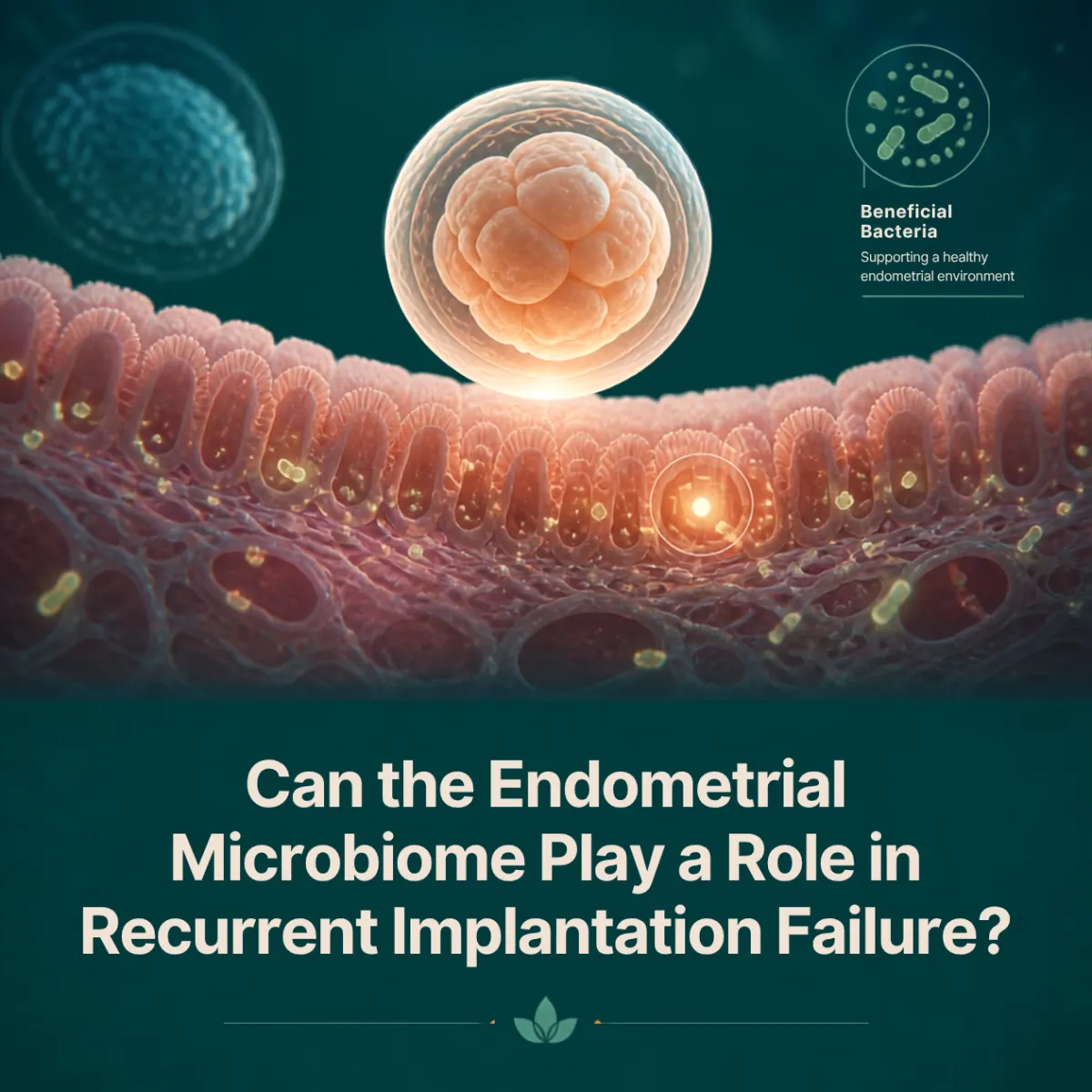
Can the Endometrial Microbiome Play a Role in Recurrent Implantation Failure?
Can the Endometrial Microbiome Play a Role in Recurrent Implantation Failure?
Introduction
Experiencing multiple unsuccessful embryo transfers can be one of the most frustrating parts of the IVF journey. When good-quality embryos repeatedly fail to implant, many patients begin asking, "What are we missing?"
One area receiving increasing attention is the endometrial microbiome—the community of microorganisms that naturally lives within the uterine lining. Although research is still developing, scientists are investigating whether changes in this delicate microbial environment may influence endometrial receptivity and implantation.
While the endometrial microbiome is unlikely to explain every case of recurrent implantation failure (RIF), it represents one of several factors researchers are studying to better understand why implantation sometimes does not occur.
What Is Recurrent Implantation Failure?
Although definitions vary among fertility specialists, recurrent implantation failure generally refers to repeated unsuccessful embryo transfers despite the transfer of good-quality embryos.
When this happens, physicians often evaluate multiple possible contributing factors, including:
Embryo quality
Chromosomal abnormalities
Uterine anatomy
Hormonal balance
Immune factors
Blood-clotting disorders
The endometrial environment, including the microbiome
Rather than focusing on a single cause, fertility specialists typically investigate several possibilities to develop the most appropriate treatment plan.
Why Researchers Are Interested in the Endometrial Microbiome
A healthy endometrial microbiome is often characterized by a predominance of beneficial Lactobacillus species, although researchers continue to refine what defines a "healthy" uterine microbiome.
Some studies have reported that women with microbial imbalance (dysbiosis) may experience different implantation outcomes than women with Lactobacillus-dominant microbiomes. Researchers believe the microbiome may influence:
Local immune regulation
Inflammatory responses
Endometrial receptivity
Communication between the embryo and uterine lining
However, these relationships remain an active area of investigation, and scientists continue to study exactly how these microorganisms may affect implantation.
What Does the Research Show?
Research has identified associations between certain microbial patterns and implantation outcomes, but it has not established that microbiome changes directly cause recurrent implantation failure.
Some studies suggest that correcting dysbiosis may improve the uterine environment in selected patients, but there is currently no universal treatment approach, and additional high-quality clinical studies are needed.
For this reason, most fertility specialists consider microbiome evaluation only as one component of a comprehensive fertility assessment.
What Should Patients Do?
If you've experienced multiple unsuccessful embryo transfers, it's natural to look for answers.
Talk with your reproductive endocrinologist about whether additional evaluation may be appropriate in your specific situation. Depending on your medical history, your physician may recommend further testing or discuss whether microbiome testing is appropriate as part of your individualized care.
Most importantly, remember that recurrent implantation failure is rarely caused by a single factor. Modern fertility care looks at the entire clinical picture to help identify the best path forward.
Final Thoughts
The endometrial microbiome represents one of the most exciting areas of fertility research today. While many questions remain, ongoing studies continue to improve our understanding of how the uterine environment may influence embryo implantation.
As research advances, microbiome science may become an increasingly valuable tool in helping fertility specialists personalize IVF treatment and improve reproductive outcomes.