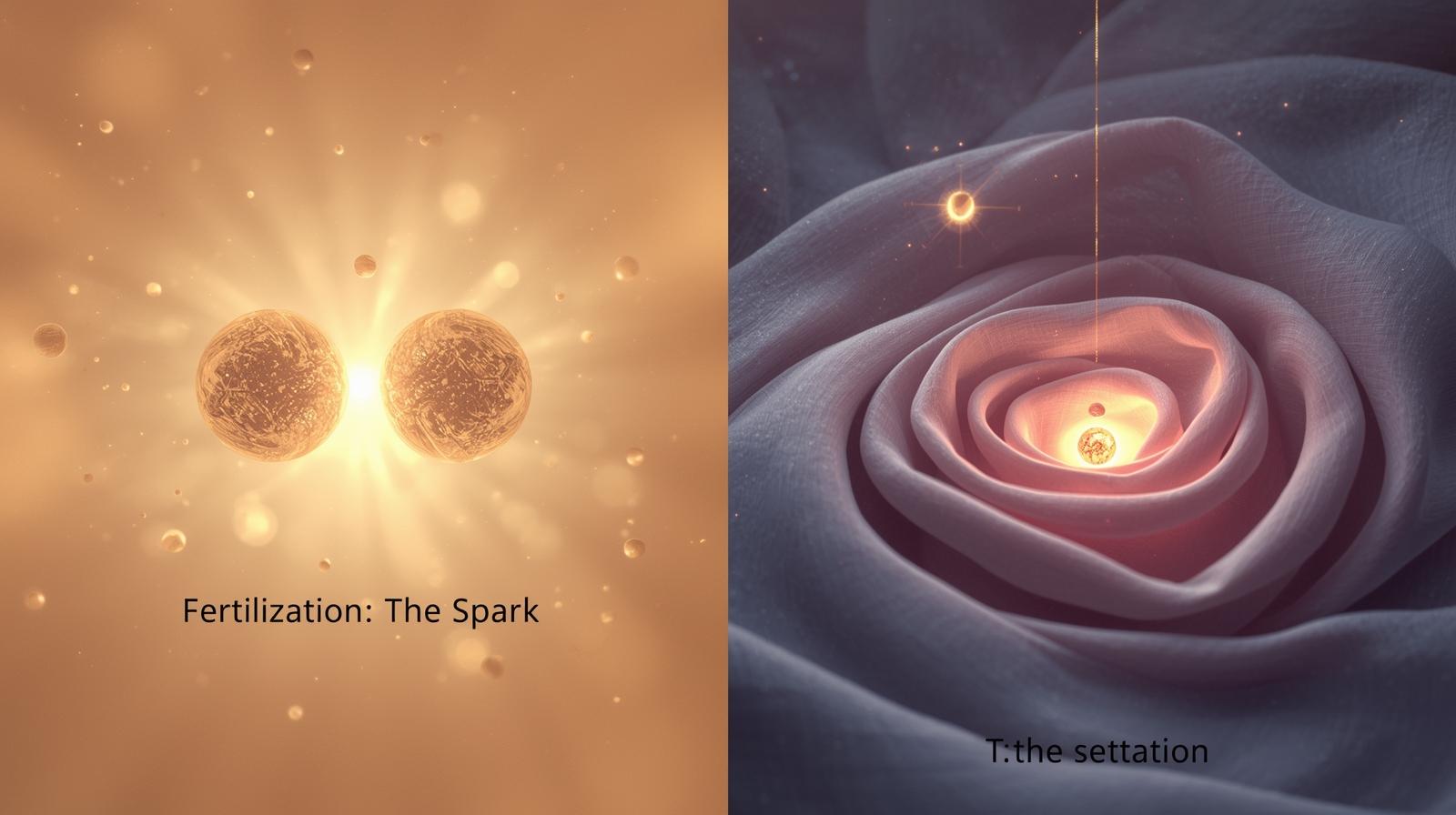
Fertilization and Implantation: The Moment of Conception
The stage is set. The sperm have completed their marathon, and a mature egg is waiting in the fallopian tube. Now, we arrive at the two-part miracle that marks the very beginning of a new life: fertilization and implantation.
Part 1: Fertilization
Fertilization is the moment a single sperm penetrates the outer layer of the egg. While several sperm may reach the egg, a special reaction occurs the instant the first one breaks through, creating a protective shield around the egg that prevents any others from entering.
Once inside, the genetic material from the sperm fuses with the genetic material from the egg. This fusion creates a single-celled organism called a zygote. This brand-new cell contains a complete set of 46 chromosomes—23 from the egg and 23 from the sperm—forming a unique genetic blueprint for a new individual.
The journey is far from over. Immediately after fertilization, the zygote begins a process of rapid cell division while it travels down the fallopian tube toward the uterus. It divides into two cells, then four, then eight, and so on, becoming a structure known as a blastocyst after about five to six days.
Part 2: Implantation
The blastocyst's destination is the lush, progesterone-prepared uterine lining we built in our earlier posts. Arriving in the uterus, the blastocyst must now attach itself to the uterine wall. This process is called implantation.
The blastocyst first hatches from its protective shell and then begins to burrow into the nutrient-rich endometrium. This is a critical and delicate step. The uterine lining must be perfectly receptive, and the blastocyst must signal its presence correctly.
Once implantation is successful, the cells of the developing embryo start producing a new, vital hormone: Human Chorionic Gonadotropin (hCG). This is the hormone that pregnancy tests detect. The role of hCG is to send a powerful signal back to the corpus luteum in the ovary, telling it to keep producing progesterone. This continued progesterone supply is essential to maintain the uterine lining and protect the new, developing pregnancy.
This incredible sequence—from a microscopic meeting in the fallopian tube to a secure attachment in the uterus—is the true, biological start of pregnancy.

