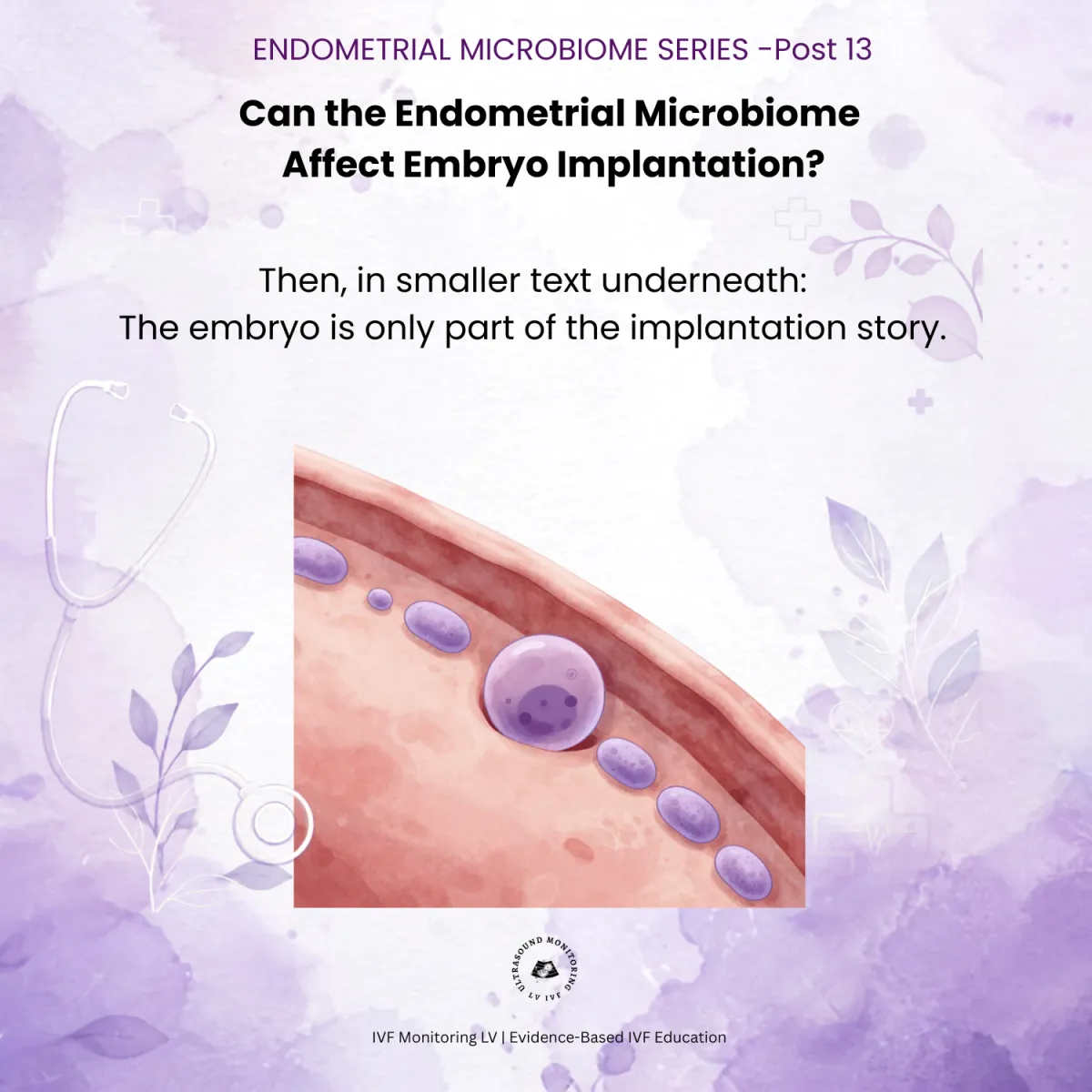
Can the Endometrial Microbiome Affect Embryo Implantation?
Can the Endometrial Microbiome Affect Embryo Implantation?
You made it through stimulation, egg retrieval, fertilization, embryo development—and finally embryo transfer.
Maybe you even transferred an embryo that had undergone genetic testing.
Then the pregnancy test was negative.
One of the hardest questions after an unsuccessful embryo transfer is:
Why didn't the embryo implant?
There isn't always one answer. Embryo quality is extremely important, but implantation also depends on what happens when the embryo reaches the endometrium—the lining of the uterus.
And researchers are increasingly studying another part of that environment: the endometrial microbiome.
Implantation requires more than a good embryo
Think of implantation as a conversation between two participants: the embryo and the endometrium.
The embryo must be capable of continuing its development. But at the same time, the endometrium must reach a receptive state during the appropriate window.
Hormones, immune signaling, inflammation, endometrial development and other biological processes all contribute to that environment.
Researchers are now investigating whether the microorganisms living within the reproductive tract may be another piece of that complicated puzzle. Recent reviews find associations between characteristics of the endometrial microbiome and implantation outcomes, although this remains an evolving area of reproductive medicine.
Where does Lactobacillus fit in?
You've probably heard me mention Lactobacillus throughout this series.
That's because several studies have found that reproductive-tract microbial communities enriched in certain Lactobacillus species are associated with better implantation, pregnancy or live-birth outcomes, while some non-Lactobacillus-dominant patterns have been associated with poorer outcomes.
But this needs an important caution:
Association does not prove that the microbiome caused an embryo to implant—or caused it not to implant.
Scientists are still working out what constitutes a healthy endometrial microbiome, how best to sample it, which organisms matter most, and whether changing the microbiome actually improves IVF outcomes. The uterus is also a low-biomass environment, which makes microbiome testing particularly susceptible to contamination and difficult to interpret.
Could an imbalance interfere with implantation?
One possibility being investigated is dysbiosis—a disruption in the microbial community.
Researchers have proposed several ways dysbiosis might influence implantation, including changes in inflammation, immune signaling and the integrity of the endometrial environment.
Studies of IVF patients have reported differences in microbial patterns between women with successful and unsuccessful outcomes. For example, one study following women after a failed IVF/ICSI cycle found higher relative abundance of Lactobacillus crispatus among women who subsequently achieved a live birth.
That's intriguing—but it still doesn't mean that every failed transfer should be attributed to bacteria.
A failed transfer does NOT mean you have an abnormal microbiome
This may be the most important point in this article.
Implantation failure can have many potential contributors, including embryo factors, uterine anatomy, endometrial receptivity and other maternal or biological factors. Sometimes no clear explanation is found.
So microbiome testing shouldn't be presented as the missing test every IVF patient needs.
Current evidence is promising, particularly in selected patients with recurrent implantation failure or chronic endometritis, but researchers continue to call for better standardized testing and larger, higher-quality prospective studies.
The question worth asking
If you've experienced an unsuccessful embryo transfer—particularly more than once—the question doesn't have to be:
“Is my microbiome causing this?”
A better question for your fertility specialist may be:
“We've evaluated the embryo. Is there anything about my uterine or endometrial environment that we should investigate before another transfer?”
That opens a much broader and more useful conversation.
Because IVF isn't only about creating an embryo.
Implantation is about what happens when that embryo meets the uterus.
Joyce's Take
After working with IVF patients for many years, one thing I want women to understand is that a failed transfer doesn't automatically tell us why it failed.
When patients hear that they had a “good embryo,” it's natural to wonder how the transfer could still be unsuccessful.
That's why I think understanding the endometrium matters. The microbiome may eventually prove to be an important part of that picture for some patients—but it is one piece of a much larger implantation puzzle.
The goal isn't to give you another thing to worry about.
It's to help you understand the questions you can ask.
Joyce Edwards, RDMS, L.Ac.
Acupuncturist and ultrasound technologist with over 45 years of experience.