
Ultrasound Monitoring for Your IVF Cycle
LATEST FROM THE IVF EDUCATION BLOG
New IVF research and education explained in language you can understand.
Expert IVF Ultrasound Monitoring in Las Vegas & Henderson"
Schedule Your Appointment
How to Schedule Your IVF Monitoring Appointment
IVF Monitoring LV is conveniently located inside True Health Acupuncture.
Call to Schedule
702-475-0870
Calls are answered by True Health Acupuncture, home of IVF Monitoring LV.
When calling, simply say:
I'm calling to schedule an appointment with IVF Monitoring LV for fertility ultrasound monitoring.
Prefer to schedule online?
You can schedule through the True Health Acupuncture website. Select
Book Now to access online scheduling.
Location
1535 W Warm Springs Rd., Suite 135
Henderson, Nevada 89014
IVF Ultrasound Monitoring
Follicle Monitoring
Early pregnancy & Trimester ultrasounds
Meet Joyce Edwards, RDMS, L.Ac.
With over 45 years of experience in reproductive healthcare, Joyce specializes in fertility ultrasound monitoring and patient education.
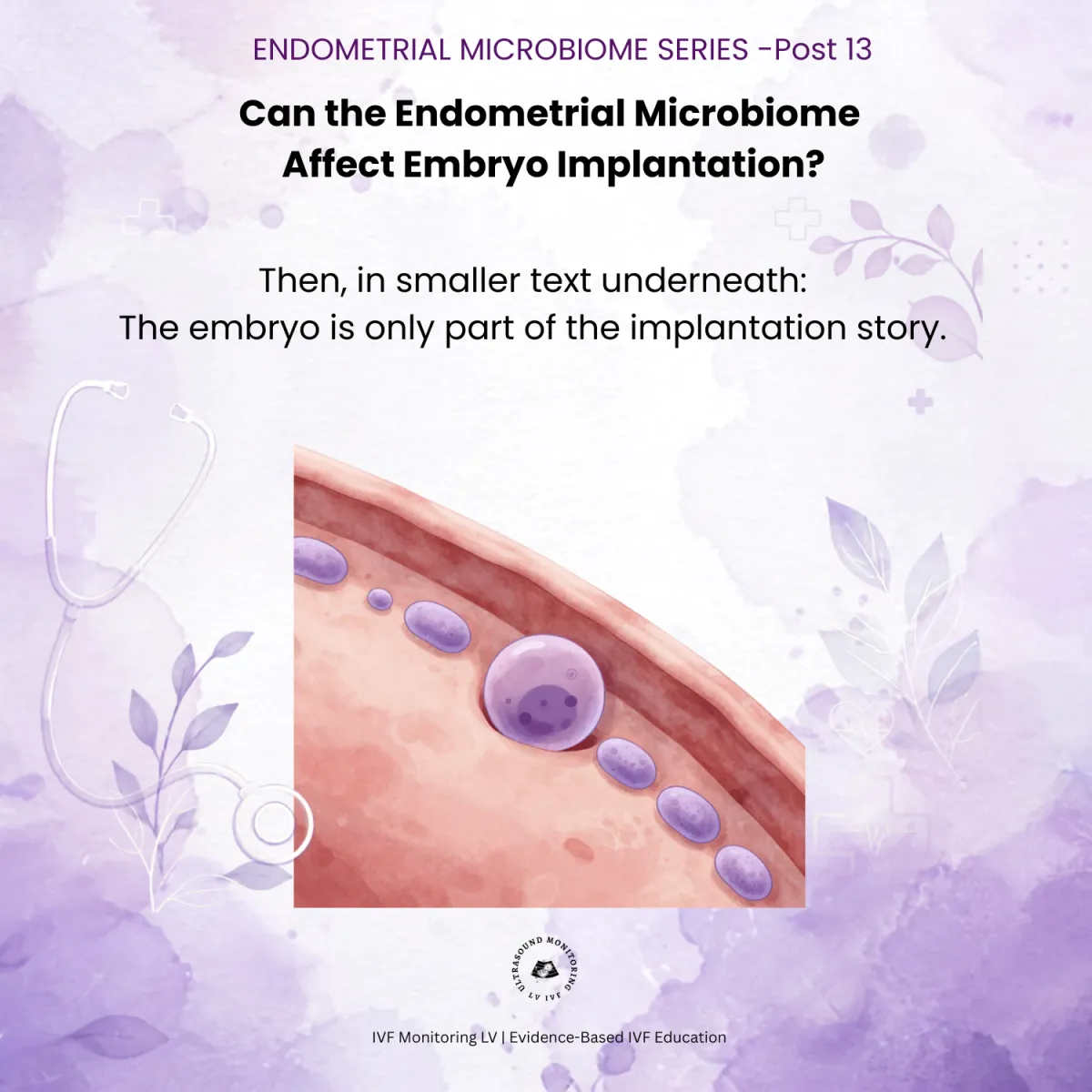
Can the Endometrial Microbiome Affect Embryo Implantation?
Can the Endometrial Microbiome Affect Embryo Implantation?
You made it through stimulation, egg retrieval, fertilization, embryo development—and finally embryo transfer.
Maybe you even transferred an embryo that had undergone genetic testing.
Then the pregnancy test was negative.
One of the hardest questions after an unsuccessful embryo transfer is:
Why didn't the embryo implant?
There isn't always one answer. Embryo quality is extremely important, but implantation also depends on what happens when the embryo reaches the endometrium—the lining of the uterus.
And researchers are increasingly studying another part of that environment: the endometrial microbiome.
Implantation requires more than a good embryo
Think of implantation as a conversation between two participants: the embryo and the endometrium.
The embryo must be capable of continuing its development. But at the same time, the endometrium must reach a receptive state during the appropriate window.
Hormones, immune signaling, inflammation, endometrial development and other biological processes all contribute to that environment.
Researchers are now investigating whether the microorganisms living within the reproductive tract may be another piece of that complicated puzzle. Recent reviews find associations between characteristics of the endometrial microbiome and implantation outcomes, although this remains an evolving area of reproductive medicine.
Where does Lactobacillus fit in?
You've probably heard me mention Lactobacillus throughout this series.
That's because several studies have found that reproductive-tract microbial communities enriched in certain Lactobacillus species are associated with better implantation, pregnancy or live-birth outcomes, while some non-Lactobacillus-dominant patterns have been associated with poorer outcomes.
But this needs an important caution:
Association does not prove that the microbiome caused an embryo to implant—or caused it not to implant.
Scientists are still working out what constitutes a healthy endometrial microbiome, how best to sample it, which organisms matter most, and whether changing the microbiome actually improves IVF outcomes. The uterus is also a low-biomass environment, which makes microbiome testing particularly susceptible to contamination and difficult to interpret.
Could an imbalance interfere with implantation?
One possibility being investigated is dysbiosis—a disruption in the microbial community.
Researchers have proposed several ways dysbiosis might influence implantation, including changes in inflammation, immune signaling and the integrity of the endometrial environment.
Studies of IVF patients have reported differences in microbial patterns between women with successful and unsuccessful outcomes. For example, one study following women after a failed IVF/ICSI cycle found higher relative abundance of Lactobacillus crispatus among women who subsequently achieved a live birth.
That's intriguing—but it still doesn't mean that every failed transfer should be attributed to bacteria.
A failed transfer does NOT mean you have an abnormal microbiome
This may be the most important point in this article.
Implantation failure can have many potential contributors, including embryo factors, uterine anatomy, endometrial receptivity and other maternal or biological factors. Sometimes no clear explanation is found.
So microbiome testing shouldn't be presented as the missing test every IVF patient needs.
Current evidence is promising, particularly in selected patients with recurrent implantation failure or chronic endometritis, but researchers continue to call for better standardized testing and larger, higher-quality prospective studies.
The question worth asking
If you've experienced an unsuccessful embryo transfer—particularly more than once—the question doesn't have to be:
“Is my microbiome causing this?”
A better question for your fertility specialist may be:
“We've evaluated the embryo. Is there anything about my uterine or endometrial environment that we should investigate before another transfer?”
That opens a much broader and more useful conversation.
Because IVF isn't only about creating an embryo.
Implantation is about what happens when that embryo meets the uterus.
Joyce's Take
After working with IVF patients for many years, one thing I want women to understand is that a failed transfer doesn't automatically tell us why it failed.
When patients hear that they had a “good embryo,” it's natural to wonder how the transfer could still be unsuccessful.
That's why I think understanding the endometrium matters. The microbiome may eventually prove to be an important part of that picture for some patients—but it is one piece of a much larger implantation puzzle.
The goal isn't to give you another thing to worry about.
It's to help you understand the questions you can ask.
Joyce Edwards, RDMS, L.Ac.
Acupuncturist and ultrasound technologist with over 45 years of experience.

Understand IVF With Confidence
IVF involves complex decisions, unfamiliar terminology, and a lot of information to absorb quickly. The IVF Clinical Guide explains the science, treatment process, monitoring, testing, and laboratory procedures in clear, patient-friendly language.
Designed to help you better understand your treatment and have more informed conversations with your fertility team.
Intro Offer · $7
Subscribe to IVF, Explained
Our monthly newsletter brings you clear, evidence-based IVF education, fertility research updates, and practical information to help you better understand your IVF journey.
What patients are saying
Michelle A.
" Joyce at True Health Acupuncture is probably the best ultrasound technician I have ever had. She’s very personal and talks through everything… The comfort environment at True Health Acupuncture is unmatched. I highly, highly recommend her.”
— Michelle A.
IVF Monitoring Patient
Sara P.
“Joyce made my IVF monitoring experience so much easier. She explained what she was seeing during each ultrasound and always made me feel comfortable and informed. I highly recommend her to anyone going through IVF.”
-Sara P.
IVF Monitoring Patient

Nicole B.
“Joyce is an exceptional individual who made a significant impact during my IVF journey. Her ability to confirm our twin pregnancy was incredibly reassuring. Joyce took the time to explain everything she was observing, which not only made the experience more memorable but also helped alleviate my anxiety.”
— Nicole B.
IVF Monitoring Patient
Have You Been a Patient of IVF Monitoring LV?
We’d love to hear about your experience. Your feedback can help other patients feel more informed and comfortable as they navigate their fertility journey.
Starting Your IVF Cycle Away From Your Fertility Clinic?
If your fertility clinic is outside Las Vegas, you may be able to complete your required ultrasound monitoring locally instead of traveling back to your clinic for every appointment.
IVF Monitoring LV follows your fertility clinic's monitoring instructions and sends your results back to your care team after your examination.
How Can We Help You?
Need an Ultrasound Appointment?
Schedule IVF monitoring, pregnancy ultrasound, or OB/GYN ultrasound services.
Interested in IVF Support?
Learn about becoming a Founding Member and receiving additional IVF education and support.
Have a Quick Question?
Not sure where to start? Send Joyce a text with a quick question.
Fast Reporting
Experienced IVF Monitoring
Flexible Scheduling
A Supportive Environment
Our Services & Pricing
Ready to Schedule Your IVF Monitoring?
Whether your fertility clinic is in Las Vegas, another state, or overseas, IVF Monitoring LV can coordinate your ultrasound monitoring with your treatment team.
Initial D3-4 Transvaginal Exam: $175
Follicle Study: $125
Transvaginal Pregnancy Exam: $125
1st Trimester Pregnancy Exam: $100
Pregnancy Growth Exam : $125
20-Week Anatomy Exam: $225
Weekend or After-Hours Appointment : Additional Fee: $50
Conveniently Located in Henderson
IVF Monitoring LV services are provided at True Health Acupuncture in Henderson, Nevada. Appointment calls and scheduling are handled through the True Health Acupuncture office.
© 2026 IVF Monitoring LV - All Rights Reserved Privacy Policy | Terms of Use & Medical Disclaimer


